8090
书名:女婴起名王者荣耀|作者:笑无语|本书类别:古言|更新时间:12:53:03|字数:3896字
A | KHIAM, Lebanon -- A Reuters videographer killed in Israeli shelling of southern Lebanon was laid to rest in his hometown Saturday in a funeral procession attended by hundreds of people.Draped in a Lebanese flag, Issam Abdallah’s body was carried on a stretcher through the streets of the southern town of Khiam, from his family’s home to the local cemetery.Dozens of journalists and Lebanese lawmakers attended the funeral.Abdallah was killed Friday evening near the village of Alma al-Shaab in south Lebanon when an Israeli shell landed on a gathering of international journalists covering exchange of fire along the border between Israeli troops and members of Lebanon’s militant Hezbollah group. The Lebanese army said in a statement Saturday that Israeli troops fired a shell the day before hitting a civilian car used by journalists killing Abdallah and wounding others. The army said that other areas in south Lebanon at the time were targeted by an Israeli helicopter gunship and artillery, including the outskirts of the villages of Marwaheen, Kfar Chouba, Aita al-Shaab and Odaisseh.Lebanon’s Foreign Ministry asked Beirut’s mission to the United Nations to file a complaint against Israel over Friday’s shelling, calling it a “flagrant violation and a crime against freedom of opinion and press.” The statement was carried by the state-run National News Agency.Israeli military spokesperson Lt. Col. Richard Hecht told The Associated Press in Jerusalem on Saturday, “We are aware of the incident with the Reuters journalist and we are looking into it.”Hecht did not confirm that the journalists had been hit by Israeli shells, but called the incident “tragic,” adding, “we’re very sorry for his death.”Reuters said in a statement that two of its journalists, Thaer Al-Sudani and Maher Nazeh, were wounded in the same shelling, while Qatar’s Al-Jazeera TV said its cameraman Elie Brakhya and reporter Carmen Joukhadar, were wounded as well.France’s international news agency, Agence France-Presse, said two of its journalists were also wounded. They were identified as photographer Christina Assi, and video journalist Dylan Collins.AFP reported Saturday that Assi was in need of blood transfusions at the American University Medical Center in Beirut where she was hospitalized. The Lebanon-Israel border has been witnessing sporadic acts of violence since Saturday's surprise attack by the militant Palestinian group Hamas on southern Israel.Journalists from various countries have been flocking to Lebanon to monitor the situation.。
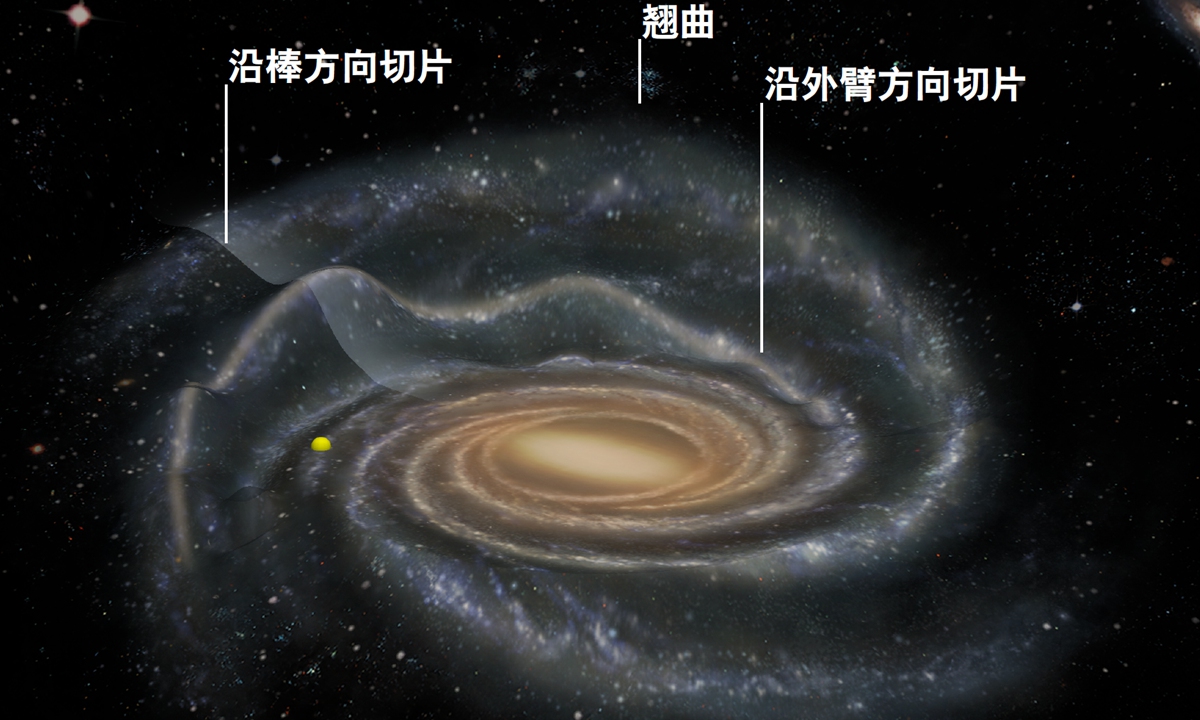
Chinese astronomers have discovered that the Milky Way is not a simple, smoothly warped disk, but contains widespread "wrinkle-like" structures resembling ripples on a water surface, providing new clues to understanding the galaxy's 3D structure and evolutionary history.
The discovery was made by a research team from the Purple Mountain Observatory (PMO) under the Chinese Academy of Sciences, using data from the "Milky Way Imaging Scroll Painting" (MWISP) survey. The findings were published online titled "Widespread corrugations superimposed on the Galactic warp in the outer CO disk" in the journal Nature Astronomy on August 7.
For decades, astronomers have known that the Milky Way's disk is not perfectly flat. Instead, its outer regions are slightly bent upward on one side and downward on the other - a structure known as a galactic warp.
However, the latest study shows that this large-scale bending is not the whole story. Smaller-scale vertical fluctuations are also embedded within the warped disk, creating a more complicated 3D structure.
"In many illustrations and in the public imagination, the Milky Way looks like a flat vinyl record," Sun Yan, associate researcher at PMO and the first author of the paper, told the Global Times on Tuesday. "In reality, the outer part of the Milky Way is more like a record that has been heated and deformed, with one side lifted and the other side lowered. That is the warp. On top of this large-scale deformation, there are additional smaller waves, which we call corrugations," Sun explained.
Using a more everyday analogy, Sun compared the Milky Way's structure to a sea surface. The warp is like a large swell that changes the overall height of the ocean, while corrugations are smaller waves superimposed on that swell.
"The two structures exist together. In our data analysis, we first removed the large-scale warp model, which allowed us to reveal the smaller wave-like patterns hidden underneath," Sun said.
The research focused on the Milky Way's outer gas disk rather than the more familiar stellar disk. According to Sun, cold molecular gas and stars provide two complementary ways to study the galaxy.
"Molecular gas is a sensitive probe for studying the vertical structure and dynamics of the galactic disk because it is concentrated near the disk plane and responds strongly to disturbances," she said.
Molecular gas is also the raw material for star formation, meaning its distribution is closely connected with the formation of young stars. The researchers traced this gas through carbon monoxide (CO) emission, which can penetrate regions obscured by interstellar dust and provide a different perspective from optical observations of stars.
The breakthrough was made possible by the MWISP survey, conducted using China's 13.7-meter millimeter-wave telescope.
"MWISP can be understood as giving the Milky Way a large-scale medical examination using millimeter-wave observations," Sun said.
Previous CO surveys were limited in sensitivity and coverage, making it difficult to accurately study the distant outer regions of the galaxy. In contrast, the latest study identified more than 30,000 molecular cloud samples, covering about half of the Milky Way's outer disk and extending to a distance of about 26 kiloparsecs from the Galactic center.
With such a large dataset, researchers were able to first establish a model of the overall warp and then separate subtle structures from the background. The newly identified corrugations have radial wavelengths of about 3.9-7.9 kiloparsecs and vertical amplitudes of about 100-200 parsecs.
The study also identified a corrugation structure extending about 40 kiloparsecs in azimuth at a distance of around 12.7 kiloparsecs from the Galactic center. In some spiral arm regions, vertical displacements can reach approximately 200 parsecs.
The researchers believe these large-scale vertical fluctuations are likely related to "bending waves" triggered by external gravitational disturbances, suggesting that the Milky Way might have experienced more complex interactions during its evolutionary history.
Although the newly discovered structures sound dramatic, they do not have any direct impact on Earth or the solar system. "Humans cannot directly sense these corrugations," Sun said. "Their scales reach thousands or even tens of thousands of light-years, and even if these structures are evolving, such changes would not be directly perceptible on human timescales."
The study focuses on the outer disk of the Milky Way and does not include the region around the solar system. "There is currently no evidence that these structures have any observable influence on Earth's environment," Sun said.
Instead, their significance lies in what they reveal about the past. Like geological layers recording Earth's history, these galactic structures preserve traces of the Milky Way's evolutionary journey, the researchers explained.
Researchers said future studies combining more precise motion measurements and numerical simulations could further reveal the origins of these structures and their role in the long-term evolution of the Milky Way.
。


